|
The jurisprudence of [religious] tolerance
as an individual liberty originated first in the New World on Governors Island - NY State's birthplace in 1624 and its most
historic landmark. The Tolerance Park Foundation seeks to safeguard the Island's national symbolism and vital message of tolerance
as a reciprocal dynamic in the conception of American freedom through broad awareness via a sustainable development. A Tolerance Park with a Tolerance Monument as centerpiece exemplifies this universal value as
the foundational principle for liberty that lies at the root of America as a secular, democratic republic wherein all religions,
ethnicities and races are "equal" and therefore free. Thus revealing the Island's unique facet of history and relevance
in tomorrow, three NY Harbor islands will compose a tableau of America's interdependent, elemental values - Tolerance (Governors
Island), Liberty (Liberty Island) and Welcome (Ellis Island) - in an omnipresent National Heritage Triangle.
| Honor racial tolerance in implicit MLK monument |
|
| The appropriated image of Broken-Obelisk by Barnett Newman venerating Martin Luther King Jr. |

Reimagining Liberty TOLERANCE OVER RACE CAN SPREAD Tolerance in Tomorrow
The twin concepts of Tolerance and Liberty define the juridical and cultural construct to
which American Freedom refers and on which successful pluralism depends. An island triad of America's primary values in NY
Harbor ― the Governors Island Tolerance Monument as the universal embodiment of the vibrant force of Tolerance
in the conception of American Freedom, the Statue of Liberty on Liberty Island and the American Immigration Museum on Ellis
Island ― composes a National Heritage Triangle of uniquely historic islands as National Symbols and as visual sentinels
of American Freedom and beacons to humanity. (a) Culturally, the reciprocal dynamic of Tolerance ― America's fundamental freedom
principle ― fosters freedom-for-all in the United States of America through shared awareness, joint understanding
and mutual respect. As a Common Theme, it transforms diversity ― merely an observed, static fact ― into
a vigorously formed, flourishing societal tableau. Liberty is therefore the cultural product of
the jurisprudence of Tolerance whereas Tolerance is Liberty's antecedent. They are the fraternal twins in the notion
of American Freedom. (b) Constitutionally, this freedom-for-all is protected in the Bill of Rights which abolishes
and rejects the concepts of a privileged, preferred or superior religion, ethnicity and race. Thus accepting diversity of
religion and race unconditionally, it guarantees that all religions, ethnicities and races are "equal and free."
Following a shooting
at the U.S. Holocaust Memorial Museum in Washington, DC on June 10, 2009, President Barack H. Obama said: "This outrageous
act reminds us that we must remain vigilant against anti-Semitism and prejudice in all its forms." "We will have to repent in this generation not merely
for the hateful words and actions of the bad people but for the appalling silence of the good people." (Rev. Dr.
Martin Luther King Jr., 1963)
What and Where is Religious and/or Racial Freedom?
What is Tolerance? (1)
The precept of
Tolerance is a reciprocal dynamic (that is, a two-way street.) The notion of Tolerance being selective, therefore, is
incongruous. Tolerance as a moral force in the understanding of [American] freedom is a pro-active process. It transforms
peaceably pre-modern values, attitudes and beliefs held in certain societal segments to modern Western values, norms and customs.
● As a dynamic notion in the conception of [American] freedom, Tolerance engenders debate
about ever-present differences in cultural norms and values.
● As a state of
mind, Tolerance is about reciprocity, mutual understanding, respect and full acceptance.
Cultural
values and practices imposed on individuals by groups based on exclusionary or confining aspects of religious, ethnic and
racial behavior are subordinate to individual rights given and protected by the state and may even be unlawful. For example,
the First Amendment protects religious belief where each religion is "equal and free," but doesn't necessarily
sanction religious compulsion, conduct or practices (for instance, polygamy or ritual [female] circumcision.)
In an intolerant society Liberty as a static notion is meaningless. Only
through broad awareness and conscious vigilance can liberty be sustained. The credos of Tolerance and Liberty ― fraternal twins ― thus constitute
the conception of American Freedom.
Tolerance
is the realization that postmodern humanity is determined by crucial themes of normative differences (tolerances) as standard
deviation from the mean ―
freedom. Tolerance is a universal value and was adopted
by the United Nations under its Universal Declaration of Human Rights in 1948: "Education...shall
promote...tolerance...among all nations, racial or religious groups" (Article 26-2.)
(Joep de Koning) As the historic foundation for liberty, this message has been approved, since 1998, by
U.S. Senator Hillary R. Clinton, U.S. Representative Jim Gerlach...; NY State Senators Toby Ann Stavisky, Jose M. Serrano,
Andrea Steward-Cousins, Martin Malave Dilan...; NY State Representatives Eric Stevenson, Greg Ball, Adriano Espaillat,
Albert Stirpe...; NY City Councilmember Daniel Halloran... This message was not approved (i.e., politicians
having the courage to say NO) by U.S. Representative Charles Rangel... All other politicians of the State and City
Legislatures, the U.S. Congress - including New York's Congressional Delegation - as well as the chief officials
of the Executive Branches of the United States, New York State and New York City still need to approve the above
message thus acknowledging New York's birthright and its universal theme of morality that accepts the full humanity
of others and which lies at the root of the United States of America as a secular democratic republic wherein all religions,
ethnicities and races are "equal and free," however subjected to civil law and policy.
Description of the Tolerance Monument
as Centerpiece of the TOLERANCE PARK
In the New World, religious and ethnic pluralism through Tolerance as a legal-political
condition were placed first on Governors Island in NY Harbor in 1624.
As iconic National Symbol of America's ultimate
virtue of Tolerance and common theme for social cohesion, a proposed 151 feet high Tolerance Monument will be anchored to
a 50-acre Tolerance Park on 30% of Governors Island. They will restore the Island to its historical, thematic integrity
and imbue it with its original message and historic symbolism.
This Government Island park-to-tolerance will emanate lasting loyalty to America's earliest value - the elemental
precept of Tolerance as a subset of American Freedom and as primary pillar of American culture and democracy.
The historical meaning of Governors Island lies in its existence
as unrecognized Conceptual Art since 1624 when the jurisprudence of Religious Tolerance as the basis for ethnic diversity
was delivered onto it.
Its transformation to Visual Art and National
Symbol is to be accomplished by way of the envisaged living Tolerance Park with the Tolerance Monument as centerpiece. It
will be the New World and the nation's first park that addresses issues of dynamic Tolerance as they define American Freedom
thus upholding constitutionally protected personal freedom (= Liberty) visually and intellectually.
In the way that New York City's Museum of Modern Art (MoMA)
is housed in a mixed-use skyscraper wherein about 20% is dedicated to exhibition space and 80% to residential use, the Tolerance
Park will similarly be dedicated to exhibition space devoted to interactive educational exhibits about religious, ethnic and
racial Tolerance. The remaining structures of the Tolerance Park structures will serve as America's first mixed-use
urban artist colony that focuses on arts and crafts with emphasis on vanishing arts and crafts disciplines from before the
19th-century.
The envisaged Tolerance Monument of
global meaning, thematic substance and 21st-century visual greatness will be portrayed by appropriating two ancient Egyptian
images that had been joined by the American artist Barnett Newman into a unified sculpture named Broken-Obelisk (a copy of
which is in MoMA.) It was dedicated to the memory of Dr. Martin Luther King Jr. after his assassination in 1968. The implicit
MLK monument serves thus as a tribute to Martin Luther King Jr. Relating
the Tolerance Monument's necessary depiction of harmony-in-difference or cohesiveness - central to the precept of tolerance
as a common, unifying theme - to the likeness of Barnett Newman's fusion of disparate icons will integrate Broken-Obelisk's
history, meaning and cultural value into a constructive national symbol of eternal consciousness.
By using contemporary technology, materials and engineering,
the image of Barnett Newman's incongruent union can be extrapolated to a height of 151 feet (46 meters). This height equates
that of the Statue of Liberty's without pedestal (that is, half the total Liberty Monument's height because Broken-Obelisk
stands on the ground) because Tolerance and Liberty are equal partners or the fraternal twins in the understanding of American
Freedom.
This new emblematic beacon, akin to the iconic power of
Stonehenge, will be an implicit tribute and testimonial to racial Tolerance by recognizing the fact that, for the African-American
segment of the population, Liberty was a concept from which they were largely excluded legally and culturally. Raising awareness
of Tolerance from which [American] Liberty germinates will extend the boundaries of Liberty for all mankind thus.
The image of the Barnett Newman sculpture - implicitly venerating
Martin Luther King Jr. - upon its transformation into the Tolerance Monument will comprise a Tolerance Hall to address
issues of human servitude in modernity while placing special emphasis on the portrayal of this topic in the Atlantic arena from the 15th through 17th centuries.
The contemporary relevance of such an exhibit may
best be underscored by the fact that, today, there are more chattel slaves in the world than ever before: between 12 to 27
million. This is in spite of the United Nations' 1948 Universal Declaration of Human Rights, in Article 4, that "No one shall be held in slavery or servitude; slavery and the slave trade shall be prohibited in all
their forms."
It will highlight uplifting exhibits and narratives of Herculean
courage as inspirational demonstrations of humanity's capacity for astonishing compassion that emerges from the depths of
depravity and indifference. The color of the pyramid section will be black to reflect its theme: "Black has an innersound
of nothingness bereft of possibilities, a dead nothingness as if the sun had become extinct" so wrote Kadinsky.
Because black's cognate is blue, the upside-down obelisk
section will be translucent to radiate blue light as a blue-sky tribute to mankind's power to rise and create ex nihilo. It
will be situated on the same spot within the Tolerance Park as where Fort Amsterdam as Capitol was positioned within New Amsterdam,
now New York City.
Just as when Governors Island became
the region's first crossroad of three cultures in 1613 when Jan Rodrigues from Santo Domingo and of African and European ancestry
summered there, the Tolerance Park, when it opens in September 2009, will become a meeting point for the cultures of the world
to debate on these issues of profound importance to future generations.
The Tolerance Park will be of architectural uniqueness and cohesiveness and therefore reflective
of harmony-in-difference - the ideal condition of the virtue of Tolerance. It will be a place where 350 years of contrasts
will visually dissolve harmoniously into a new and unique village, just as divergences and boundaries melt away through the
ethical force of Tolerance into common humanity.
Consequently,
the Tolerance Park will link visually the 1624 historic planting of [Religious] Tolerance (that is, the "father"
of American Liberty and the basis of successful pluralism) on Governors Island with broad 21st-century awareness of that dynamic
ethical force as being indispensable to religious, ethnic and racial Liberty in contemporary American society.
*************************************
Transformation of Governors Island through the Tolerance Park:
The French gift of the Statue of Liberty (inaugurated
in 1886) transformed Bedloe Island to Liberty Island in 1956 to become an omnipresent, fundamental American symbol.
Similarly, our proposed 50-acre canvas for the creation of a masterpiece of thematic
and visual excellence―the Tolerance Park wherein situated the Tolerance Monument as centerpiece―will transform
Governors Island, over time, to Tolerance Island.
The envisaged canvas for
profound creativity will explicitly acknowledge constructive pluralism-through-tolerance as an original, historic, indispensable
dynamic notion in American freedom since 1624―the year in which it took root on the very place where it was planted
first on Governors Island in the Western Hemisphere. The 50 acres for the work of art―legislatively
set aside for that purpose―will generate the third iconic island symbol as a quintessential, fundamental American symbol
in New York harbor.
Governors Island, the nation’s oldest natural, historic,
primary symbol since 1624, precedes the later created island symbols (“Liberty” by way of the Statue of Liberty
and “Welcome” by way of the American Immigration Museum) in historical priority and national meaning. These three symbols happen to be ideal complements and are fully interdependent with respect to a more insightful
understanding of what constitutes American freedom.
Each island embodies
a unique facet of its own history that is inherent to the way we experience personal freedom.
Geographically perfectly aligned in a triangle, the island triad thus composes a new, timeless American icon:
The National Heritage Triangle.
It will
provide our children with an opportunity to understand the twin notions of tolerance and liberty of American freedom and imbue
them with a deeper appreciation of the meaning of freedom in a pluralist society through broad awareness and conscious vigilance.
The envisaged park will therefore protect the nation’s ideal and tradition of tolerance
and uphold America’s ultimate, active virtue to the world while preserving the national significance of Governors Island's
historic symbolism as an enduring beacon to humanity.
*************************************
What is Tolerance? (2)
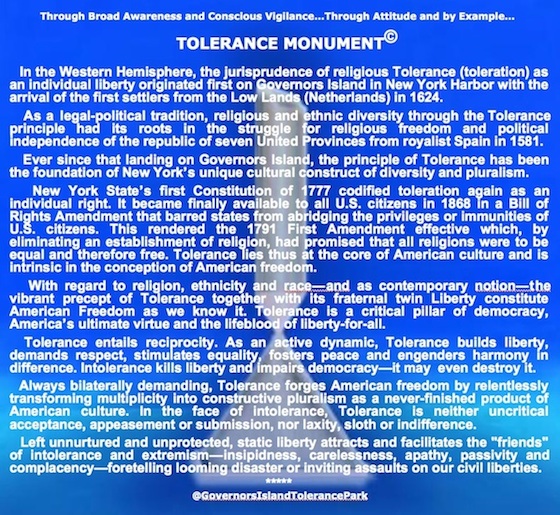
The jurisprudence of religious tolerance as an individual right was introduced first in the Western
Hemisphere as a legal-political and cultural tradition in 1624. In that year, the precept of Toleration was placed on Governors
Island in New York Harbor with the landing of the first settlers to the New York Tri-State region. This legal notion is the
foundation of New York's unique characteristic of cultural diversity and pluralism, and New York State's juridic patrimony.
This Tolerance of the year 1624 had its roots in the independence of the Dutch Republic from Spain in 1581. It was re-introduced
as a legal-political and individual right in New York's first State Constitution of 1777 and codified in 1791 as an amendment
to the U.S. Constitution in the Bill of Rights after the formation of the republic of thirteen United States in
1776.
(1) As an ethical force, Tolerance lies thus at the core of American culture and is America's ultimate virtue.
(2) As a prerequisite to sustainable liberty, the limits of tolerance also set the standards of liberty and societal
freedom itself.
(3) With regard to religion, ethnicity and race, the partners Tolerance and Liberty constitute the conception
of American freedom. Hence, the vibrant notion of Tolerance is a subset of American freedom as well as a crucial pillar of
a secular democratic republic--the United States of America. Tolerance is the lifeblood of American liberty as we know it.
(4) As an active dynamic, Tolerance entails reciprocity and reciprocal respect. Always bilaterally demanding, it forges
Western/American freedom by relentlessly transforming plurality into constructive pluralism as a never-finished product of
Western culture.
(5) Globally, Tolerance is pivotal
in the concept of freedom-for-all (i.e., liberty) by transcending cultural/national borders in order for humanity to function.
(6) In the face of Intolerance, Tolerance is neither uncritical acceptance, appeasement or submission, nor laxity, sloth
or indifference. Left unnurtured and unprotected, simple liberty invites and facilitates the "friends" of intolerance
and extremism---complacency, carelessness, apathy, passivity and insipidness--opening the door to insidious assaults on civil
liberties.
(7) Tolerance builds liberty. Intolerance kills liberty. It impairs democracy and may even destroy it.
(8) Tolerance is not about promoting religion, ethnicity or race or, for that matter, anything else that involves the pursuit
of one's self-interest. Nor is it about advancing the individual pieces of the living mosaic at the expense of other fragments
that compose the American tableau.
(9) Tolerance is the cement that holds the individual pieces of the living mosaic
together for it to be seen in its fullest glory. It is about being alert and respectful of all its segments. Only then can
its overall beauty be sustained for the enjoyment of those willing to see it--for the common good and in the public interest.
(10) The locus of this quintessential American precept as a condition to liberty is Governors Island--New York State's
official birthplace. When set aside for the visualization of this timeless message by the New York State Legislature, the
Island will instill confidence in the dependable and binding power of tolerance and conciliation as indispensable to the concept
of American freedom.
(Joep de Koning) ********************************************* The only freedom which deserves the name, is that of pursuing our own good in our own way, so long
as we do not attempt to deprive others of theirs, or impede their efforts to obtain it. Each is the proper guardian of his
own health, whether bodily, or mental and spiritual. Mankind are greater gainers by suffering each other to live as seems
good to themselves, than by compelling each to live as seems good to the rest. (John Stuart Mill, 1869.) *********************************************
What is Tolerance? (4) Tolerance is not concession,
condescension or indulgence. Tolerance is, above all, an active attitude prompted by recognition of the universal human rights
and fundamental freedom of others...Tolerance is respect, acceptance and appreciation of the rich diversity ot our world's
cultures, our forms of expression and ways of being human. It is fostered by knowledge, openness, communication, and freedom
of thought, conscience and belief. Tolerance is harmony in difference. It is not only a moral duty, it is also a political
and legal requirement. (Unesco's Declaration of Principles on Tolerance, November 16, 1995) *********************************************
|